The Tarrant Scholarship provides funds for selected third-year medical students from the University of Alberta and University of Calgary who demonstrate a strong interest in developing their career in rural medicine.
Established in 2004, the scholarship honours the late Dr. Michael Tarrant, a family physician and champion of rural medical undergraduate education and the development of physicians dedicated to delivering health care in rural Alberta.
The Tarrant Scholarship Selection Committee extends thanks to all who submitted an application that closed on June 1, 2025. Now, it is time to celebrate the 2025 recipients!
2025 Scholarship recipients
Kayla Fitzpatrick, University of Calgary
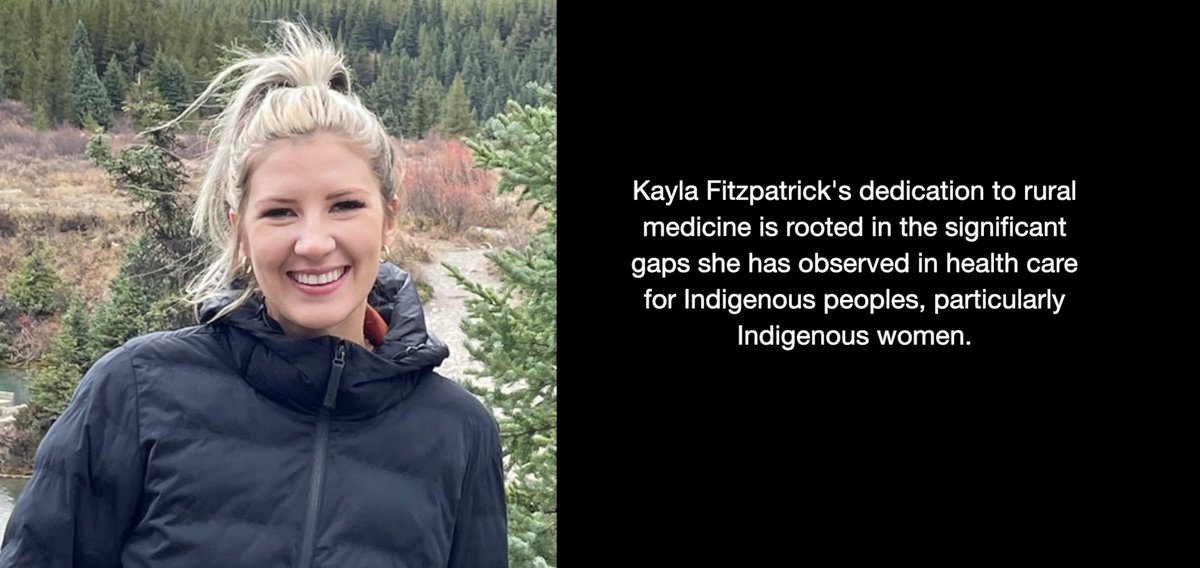
Kayla Fitzpatrick was born and raised in Fort McMurray, Alberta, where most of her family still resides, including her parents, siblings, and 41 first and second cousins. She is grateful for the love and support of her community and large family, which have shaped the person she is today.
As the first in her family to become a physician, Kayla feels immense pride and privilege in having this opportunity. She shares her success with her parents, Sean and Michelle, and is proud to honour the sacrifices they made to help her achieve her dream of becoming a doctor.
Growing up in Fort McMurray, she had no physician mentors, and most of her peers and relatives pursued trades. Kayla takes great pride in being from a northern remote community, in not being a “traditional medical student,” and in paving the way for her family and others to see that it is possible to pursue their dreams – even when the odds are stacked against you.
She has witnessed firsthand the challenges of accessing health care from a remote location – whether it was a premature cousin requiring NICU care, an ailing grandparent, or most significantly, when her older sister was diagnosed with cancer in her 20s. Her sister’s diagnosis required her family to relocate to Edmonton for three months to receive treatment.
These experiences shaped Kayla’s deep commitment to rural/remote medicine, giving her a personal understanding of the barriers faced by those living far from urban centres.
Kayla is also a Mi’kmaq, French, and Irish woman, although she was not always aware of her Indigenous ancestry or that her great-grandmother was a First Nations woman.
Over the past decade, Kayla has prioritized learning about her heritage and developed a deep passion for Indigenous health. Through reconnecting with her ancestry, she has sought mentorship from Elders and been profoundly influenced by their teachings. Her Elders in northern Alberta have welcomed and made her feel at home, offering a sense of connection she had never felt before. She was honoured to help implement programs where new mothers and Elders participated in ceremonies and cultural activities aimed at fostering relationships and preserving culture, language and tradition in Wood Buffalo. Before medical school, Kayla worked for several years in community-based research and Indigenous health initiatives. She currently serves as a medical student representative on the Alberta Medical Association Indigenous Health Committee.
Her dedication to rural medicine is also rooted in the significant gaps she has observed in health care for Indigenous peoples, particularly Indigenous women. Her goal is to continue learning and to use her knowledge to help close these gaps. She understands that providing care in Indigenous communities requires more than medical knowledge and showing up to a health centre. It requires building meaningful relationships, spending time in the community, and demonstrating patience, humility, and a willingness to learn.
Kayla’s favourite role in life is being an aunty, and in her spare time she enjoys spending time outdoors with her dog Annie, practicing yoga, and reading. She hopes to give back to her hometown and to the rural, remote, and reserve communities that have welcomed and taught her throughout her journey.
Virginia Layton, University of Alberta

Virginia Layton grew up on a farm in Grassy Lake, Alberta – in a home where the doors didn’t have locks and neighbours shared tools without needing to ask. Life was tough but deeply rooted in community and resilience. There were long days that started before sunrise, and problems that got fixed with duct tape and determination. That’s the kind of grit she sees in rural patients now. Maybe it’s the respect she has for them, or the feeling of home that she craves, but ultimately, she is drawn to practicing medicine in those same kinds of places.
Virginia has spent most of her life surrounded by people who put others before themselves. They carry on through pain, weather and worry without complaint. Virginia recognizes that strength because it has shaped her. Working in rural health care has only deepened her appreciation for it. In places like High River and Medicine Hat, she had the privilege of not just performing echocardiograms, but being a trusted presence, often the most immediate access patients had to cardiac care.
Over the years, Virginia also had the opportunity to use her background in ultrasound to support diagnosis in settings where resources were limited. Whether it was guiding local physicians in Guyana on how to use donated equipment or providing echocardiograms in rural settings, she has seen how essential imaging can be when other diagnostic options aren’t available. She would love to use her years of ultrasound training where it is needed most, starting this year in Whitecourt with a PoCUS probe.
These communities don’t just need doctors – they need advocates who understand the difficulties of their lives, and she wants to be that person. Someone who listens before diagnosing, who remembers the impact of calving season and harvest before homing in on symptoms. She wants to see neighbours, not just patients. Virginia’s background, her work, and her heart have all pointed her back to rural medicine – not as an obligation, but as truly worthwhile work.
The future she envisions is one spent on gravel roads and inside tight-knit clinics, where medicine is as much about trust and relationships as it is about precision. That’s where she belongs. And that’s where she is going.
Ryan Scheltus, University of Alberta

Ryan’s sole reason to apply to medical school was to fill in the gaps that he has personally experienced in the medical system in rural Alberta. He grew up in Clive, a village of 800 people, and his wife grew up in Lousana, a hamlet of 40 people in central Alberta. They were both raised rurally and have a strong desire to return to rural and support their future community through the fields of medicine and education (his wife is an elementary school teacher).
One of the draws for him to continue to pursue rural medicine is the challenges of limited resources. When in a clinic or in the hospital, things like CT, MRI and other diagnostic techniques may not be as readily available, meaning the medical team is dependent on their own knowledge and physical exam skills to diagnose and treat patients.
There is also the added variability of day-to-day work required by rural doctors. One day you may be in the emergency room treating acutely dangerous situations, and the next day you are in the family medicine clinic doing long-term follow-up with patients. This variability is another draw for him to rural medicine, where he can get to experience acuity and the long-term care of patients. He loves following up with the same patients, celebrating their wins and consoling them throughout their health journeys. Prior to medical school, he was a teacher.
Ryan and his wife share the same goal of relocating rurally to set down their roots, begin their careers, and raise their children and family. He has leveraged opportunities in medical school to explore parts of the province that he has not previously visited in order to get more insights into where they may set up their family.
His long-term goal is to match into rural family medicine and complete a plus one year in the enhanced surgical skills program. He hopes to gain enough extra years of residency to be able to perform planned and unplanned c-sections, appendectomies, and cholecystectomies, to reduce travel time needed for treatment and to decrease the mortality associated with increased time between symptoms and surgical cure.
Where he was raised, the nearest hospital had one surgeon that retired, meaning people needed to travel to an already overwhelmed hospital in Red Deer for surgical management. Not only are there dangers associated with increased travel time with acute conditions, but often people avoid seeing the doctors and delaying treatment due to travel.
While he may not be able to single handedly stop this problem, it is his lifelong aim to alleviate some of the strain of the medical system for rural patients.
2026 Applications
Applications for the 2026 Dr. Michael Tarrant Scholarship open in January 2026.
It is bestowed each year by the Alberta Medical Association’s Section of Rural Medicine and is funded through the generosity of AMA members who select to donate to the Tarrant Scholarship.
You’re eligible to apply if:
- As of September 2026, you are enrolled in your third-year clerkship at the University of Alberta (Class of 2028) or during 2026, enrolled in your third-year clerkship at the University of Calgary (Class of 2027).
- You are keenly interested in building a career in rural medicine in Alberta.
- You have a strong connection to rural Alberta or another rural area.
- You demonstrate a dedication to rural medicine in your undergraduate work.
- You demonstrate a financial need (considered after the above criteria are assessed).
If you have any questions or would like more information, please email: [email protected]