
One afternoon clearing the garden in November, a van came up my driveway and out stepped a large, well-built man who asked if I needed any meat.
“No,” I said. “But I haven’t seen your van here before.”
“I sell meat at a big discount,” he said.
“Where are you from? I asked.
“Ukraine.”
For the next 10 minutes, we chatted about the Ukraine war. I found him interesting and informed, and ended up buying more chicken than I needed or wanted — 10 packages of deep-frozen chicken breasts and thighs for $160! Friends shook their heads: “You bought chicken from a van?” Later that day I gave a bag of chicken to my daughter, and another to a friend. In the evening I cooked a packet of chicken for dinner, ate it with a salad, and went to bed.
In the morning, to my surprise, I passed stool covered in fresh red blood. I took a sample for analysis, and brought it to the local Precision Lab. I thought that it could be a Campylobacter infection or possibly an unusual E. coli infection, although a bit early for that.
It wasn’t bad chicken (not an E. coli infection)
Four days later the sample’s report appeared on Alberta Health Services MyChart. The report was negative for bacteria, though, of course, it was obviously blood-stained. Never having previously experienced bright fresh rectal bleeding in my life before, and (with no evidence) I must have considered myself naturally immune from anything serious. Hence, I did nothing for more than six weeks until late December when I thought: “Hang on! If that fresh blood was not due to infected chicken. It must be something else.” A polyp or an internal hemorrhoid?
The most common presenting symptoms of colorectal cancer in Canada are changes in bowel habits (diarrhea, constipation) and rectal bleeding or blood in the stool. Indications for a colonoscopy include strong family history, Lynch syndrome, abnormal results from initial screening tests (like the fecal immunochemical test), or diagnostic investigation of symptoms such as rectal bleeding, unexplained weight loss, iron-deficiency anemia or persistent changes in bowel habits.
My family doctor and I decided that a fecal occult blood test should be done. It was positive and in mid-February I was summoned for colonoscopy at the Foothills Hospital in Calgary on March 6 of this year.
My colonoscopy experience
As March 6 grew closer, a referral to gastroenterology at the Foothills Hospital elicited a nurse instructional session: the necessity of a low fibre diet for some five days before the colonoscopy, followed by an intestinal clean-out using Colyte. As February folded into March, I began the low fibre diet – mainly fish, eggs and white bread – and approached the day of the colonic drainage with some interest. There was a huge amount of liquid to be drunk, first on the evening before the colonoscopy – two litres of Colyte within two hours. Two hours later I was passing a urine-coloured fluid per rectum. After an uneasy sleep, I got up early to drink the second two litres of Colyte. Alas, my stomach refused the final two glasses of liquid. But it had produced a complete intestinal clean-out.
More than 30 of us appeared for the colonoscopy at 10:30 a.m. I was put on a trolley by a nurse and given a small shot of IV Midazolam which made the time pass comfortably, then was wheeled into the colonoscopy room. Dr. M and nurse A rolled me over onto my left side, knees up and with a small dose of propofol I was off to sleep.
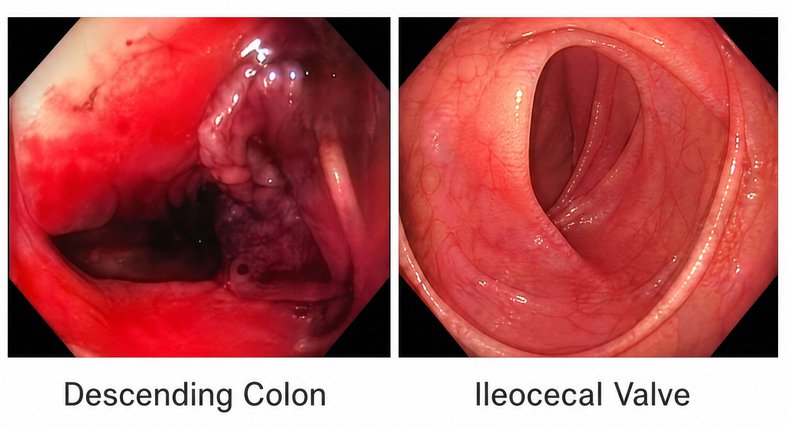
I vaguely recall coils of intestine visible on a screen, and then woke. I waited for my daughter and we went to see Dr. M for the colonoscopy results. He said I had a typical carcinoma of the sigmoid colon – a 4.5 x 3.5 cm mass surrounding half the circumference of the colon (see illustration.) Biopsies confirmed carcinoma.
Colon cancer has become the third or fourth most common cancer in Canada (depending on the reporting year) and is usually ranked as the second or third highest cause of cancer-related deaths. The incidence is declining overall in Canada likely due to screening, but is increasing in adults under 50. Rates have risen 1.8% annually in those aged 40-49 from 2002 to 2022. Younger adults are 2 to 2.5 times more likely to be diagnosed compared to previous generations. There are now calls to lower the screening age to 45. Causation remains unknown though highly processed foods are being examined.
In my career, I became an oncologist because of a fascination with the new nuclear biology in the 1950s and 60s. But this was different. Me – a cancer patient? It was a path I’d taken many patients down, but now it was me on the pathway!
Following the clear, clinical observation of the sigmoid colon mass with its histology showing an adenocarcinoma of the colon, I waited about a week and saw the surgical consultant. Dr. M had referred me to the surgical oncologist, Dr. T., and I had deliberately not mentioned to anyone my previous career as a recently retired medical oncologist with more than 50 years’ practice.
A student did my history (forgetting to take a social history — a mistake since I live on my own, my wife being in care for advanced Alzheimer’s disease). My abdomen was examined and Dr. T summarized the proposed surgical procedure for removing 10 cm of sigmoid colon with the associated mesentery and lymph nodes.
I had been delighted to get the early appointment but neglected to ask a critical question: Dr. T was going on holiday that very weekend. The following week I was given a surgical operation date of April 13, some five weeks after the colonoscopy. This wait does seem to be now quite typical for elective surgical wait times. I found the wait difficult, being anxious to get on with things, but had little problem with the diagnosis since this was a pathway I had taken many patients down – though with different malignancies – and fate is fate.
The next two weeks were taken up with a CT scan of the chest, abdomen and pelvis. On the chest CT were found small nodules at the bases of both lungs. One nodule was about 6 mm and will be followed with a scan in three months, but the liver seemed to be clear. I then saw a consultant in the Alberta Thoracic Oncology Program (ATOP) and we agreed to do a follow-up CT in three months rather than attempt to biopsy the nodule. I have a history of being PPD positive as a teenager, and was a smoker until about 1985.
I also attended a pre-admission clinic and was reviewed by the anesthesiology resident and her consultant, as well as an internal medicine specialist. I spent the next weeks keeping as fit as possible, avoiding crowds to avoid a respiratory infection. I contented myself with reviewing the natural history of colon cancer, which appears to be decreasing in incidence (due to screening) but increasing in younger adults.
My surgery experience
As March moved into April, about five days before the operation (laparoscopic removal of the sigmoid colon mass) I started a low fibre diet again in preparation for another intestinal wash-out this time using KleanLyte. I was weary of the low fibre diet, being restricted to fish, eggs and tasteless clear broths, but it’s necessary to enable a trouble-free removal of 10 cm of sigmoid colon by laparoscopy with less chance of leakage or bleeding from the colon.
I continued daily physical exercise; the surgery being set for 11 a.m. on April 13. My daughter picked me up and we drove to Foothills Hospital. I’d packed my roller bag with spare shirts, a T-shirt, jogging pants, pairs of underpants and socks, as well as toiletries – but had forgotten several items that would have to be picked up later.
We were put into seats in the admission area and after about an hour, I was changed into a gown and climbed onto a surgical trolley. My daughter took my bags to return them to my post-op bed after the surgery. I was wheeled into the surgical suite, an IV having been set up by the anesthetist, met the surgical team and noted the technical looking set-up of the operating room with much wiring and many screens. I was then anesthetized and woke in a hospital bed in a different unit. My daughter had already brought my bags back. The surgeon had contacted her and said the procedure had taken under three hours and had gone well.
Laparoscopy entails making the incisions, inserting the laparoscope and filling the abdomen with gas and inserting the surgical tools. The segment of the sigmoid was dissected out and removed, along with sections of the mesentery and associated lymph nodes. I recall feeling content with no pain, being now on hydromorphone.
My postoperative experience
Memories of the postoperative phase are hazy, but my main symptoms were abdominal pain and discomfort (particularly on rising from the bed), a lack of energy, a painful cough and discomfort on swallowing anything — likely due to the previous presence of an endotracheal tube.
The conversations in my post-op bed with the nursing staff were limited – mostly of the kind: “Passed any gas?” And then later: “Have you pooped?” If you claimed you’d “pooped,” a photograph was requested by the surgical team.
On day five postoperatively, I felt well enough to go for convalescence to a retirement community called Prominence Way. I had organized this as a respite reservation for one week since I live alone, my dog having been sent to a kennel for the time I’d be away. A friend picked me up from the Foothills and helped with my bags to the car. I filled my prescription for the low-molecular-weight anticoagulant, Tinzaparin, for a further 20 shots subcutaneously.
The convalescent home is a retirement community for the elderly and compared to most of the people there I was relatively fit and able to walk since most needed help with walkers. Here, my room is equipped with an emergency pull-line at the toilet and a push button to check in each morning indicating I’ve survived the night.
I look after my anti-hypertensive drugs myself. I stopped the Acetaminophen for a couple of days but found the abdominal discomfort increased so I went back on Acetaminophen and found it did relieve some of the pains. My appetite started to pick up, and I have progressed from a low fibre diet to introducing higher fibre foods.
For at least five to eight days post-op, the hardest part of the day is on waking with aches in the area of the left lower abdomen where the sigmoid colon has been removed. Taking Tylenol helps, and now, nine days post-op, the pain has resolved.
The final pathology report
The final pathology report remains. If the carcinoma was confined to the colon — either within the colon (stage 1) or outside the colon (stage 2), I should be alright with the surgery alone although possible chemotherapy might be advised if a risky stage 2. If the lymph nodes are involved (stage 3) then adjuvant chemotherapy would be advised.
This is a decision that induces some anxiety in most cancer patients, a group of which I am now a member, or as a friend with a serious malignancy said to me a few days ago: “Welcome to the club.”
Post-script: I now have my pathology report on MyChart. I have a Stage 2B carcinoma of the colon (32 examined lymph nodes negative) so likely no requirement for chemotherapy.
Editor’s note: The views, perspectives and opinions in this article are solely the author’s and do not necessarily represent those of the AMA.