
A patient walks into your clinic, not just with symptoms but with screenshots of heart rate trends or a glucose graph from a smartphone app. Welcome to the era of patient-generated health data (PGHD), where real-world data is increasingly informing clinical decisions.
Consider Peter (not his real name), an office worker in his 50’s I had treated previously. He initially presented with vague fatigue and intermittent palpitations. At the time, a standard ECG and 24-hour Holter monitor yielded normal results, providing no diagnostic clarity. A year later, however, Peter returned with a new piece of evidence: an irregular rhythm notification from his Apple Watch. This prompted a repeat Holter monitor, which ultimately captured two episodes of paroxysmal atrial fibrillation – finally explaining his symptoms and guiding appropriate management.
Whether through devices like the Apple Watch, Fitbit, Oura Ring or continuous glucose monitors (CGMs) such as Dexcom and FreeStyle Libre, patients are actively monitoring their health outside clinical settings. These tools provide a richer, longitudinal picture of physiological patterns that complement the brief snapshots gathered during episodic clinic visits.
Evidence behind PGHD
Several high-quality studies underscore the growing clinical relevance of PGHD.
- Physical activity and health outcomes
An umbrella review in The Lancet Digital Health (2022) that synthesized 39 systematic reviews and nearly 164,000 participants found that wearable trackers improved body composition (mean weight loss of ~1 kg), increased daily step counts by approximately 1,800 and enhanced cardio-respiratory fitness.
- Atrial fibrillation detection
The Apple Heart Study (NEJM, 2019) evaluated over 419,000 participants and demonstrated that the Apple Watch’s irregular rhythm notification had a positive predictive value of 0.84 for identifying atrial fibrillation episodes.
- Continuous glucose monitoring (CGM)
A systematic review in Diabetes Care (2024) involving 26 randomized trials found that CGM use was associated with a 0.2–0.3% reduction in HbA1c levels, which supports its clinical benefit in managing type 1 and type 2 diabetes.
Clinical value of common wearable devices
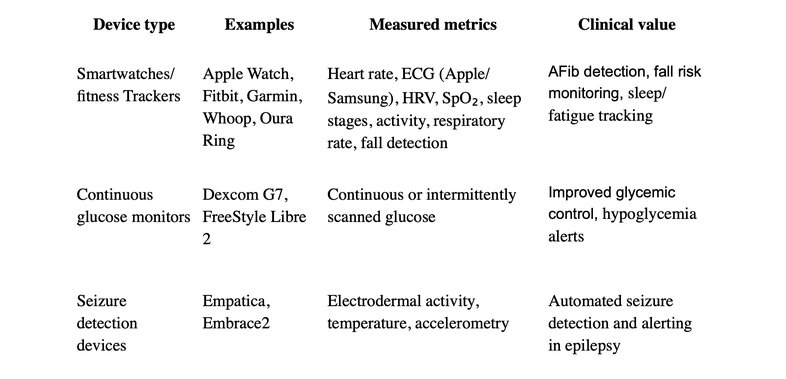
The table below summarizes common wearable devices, the metrics they measure and their possible clinical value.
Challenges and considerations
Despite their promise, wearable devices pose several challenges.
- Accuracy varies widely across manufacturers, especially for metrics like energy expenditure and sleep staging, which may mislead users or clinicians.
- Integration into clinical workflows remains cumbersome, with few electronic medical records (EMRs) offering seamless data ingestion from consumer devices.
- Privacy and data security are also pressing concerns, given that sensitive health information is often stored and managed by third-party platforms outside the health care system.
While wearables can spark positive change, their effects on broader health outcomes still remains to be seen.
Editor’s note
The views, perspectives and opinions in this article are solely the author’s and do not necessarily represent those of the AMA.
Banner image credit: Indra Abdurrahman, pixabay.com