
"When I sing, I am free." - Tina Turner
“Music heals all forms of misery.” - Friedrich Nietzsche
Different types of music and song draw out differing emotions – the joie de vivre of sailing, hiking and party songs; the excitement and dance rhythm of rock and roll; the national pride of martial music; the contentment and happiness of love songs; the pith of sense and pride of worth of working-man songs; and the deep soothing and comfort of classical music and song.
We all need emotional antidotes and promoters in this often sad and sorry world, and Shreya Jha (a medical student in Toronto who has some impressive musical compositions to her name) has written a lovely short article, published in the Humanities section of the Canadian Medical Association Journal on March 3, 2025.
“An afternoon on the hospice piano” describes Jha’s visit on a clinical attachment to a palliative care nursing home where she was invited to play the piano in the home’s sitting area. The music gave comfort to patients and relatives experiencing grief – both anticipatory grief and immediate grief – but also to herself. She describes the power of music to ameliorate the anxiety and grief of loss. Shreya came into medicine with the ambition of building connections between music and medicine, and she was herself grieving the loss of a close friend who had died at age 22.
“What do you play for people in their final days of life?” she asks.
“I reminded myself that palliative care is about comfort, and I played the opening notes of a piece I’ve often played for myself when I need comfort: Debussy’s La Fille aux Cheveux de Lin (The Girl with Flaxen Hair)”.
Listen to it. This piece of music with its pentatonic scales is lovely and sad but offers comfort and hope. And reading her short article got me thinking about all kinds of music and its enjoyment, solace and meaning to us and whether or not we use enough of it in medical practice. I think we do not. Ms Jha may well make future contributions to medicine, clinical practice and the role of music.
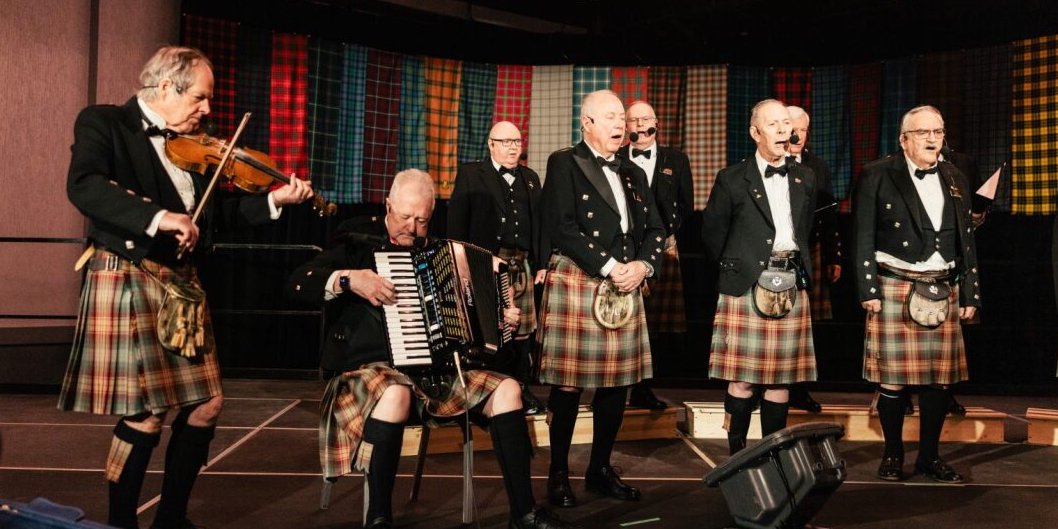
My friend Alan, who is looking after his wife with Alzheimer’s, says he’s now aware of the extraordinary power of music and singing for souls who have lost the ability to remember names, faces, talking in sentences and putting forward a rational series of ideas. Songs from childhood can remain with us for life. One can see this in the dementia unit where Alan’s wife lives. Our singers’ group have performed there. Many of the songs’ words are remembered from childhood by the patients. She sings the Philippines national anthem learned as a child when she went to school in the Philippines where her father was an international banker. The Filipina caregivers stare in astonishment at this poor demented soul, a Caucasian woman who knows their national anthem better than they do, can lead the chorus of Bayang magiliw, Perlas ng Silanganan and yet who cannot hold a conversation or remember her own children’s names.”
Singing in my childhood at school, we had a music teacher called Mr. Telfer, who was jolly and enthusiastic like the music teacher in the movie The Prime of Miss Jean Brodie. We all loved the music period. We sang international songs like So Sir Page your philandering is over from The Marriage of Figaro and Scots songs like the Mingulay Boat Song and Over the Sea to Skye or Fhir a’ Bhata (The Boatman – a lovely Gaelic song).
My own experience of singing as a teenager and then in my twenties as a medical student in Edinburgh was helped by the good fortune of having learned the violin at school. After leaving school, I put my fiddle to use with three other friends and we formed a band called the Little Brass Band and played the pubs, clubs and restaurants in Edinburgh. I made more money at weekends and occasional weekday gigs (and had a lot more fun) than I did for the first three years working as a resident physician. We were of average ability but knew how to get a crowd going. We often played at an Edinburgh café called The Stockpot, opening for The Incredible String Band, a well-known group in the 1960’s.
But not everyone likes what you do. One scary evening, we were playing on a Saturday night in a bar down in Leith, Edinburgh’s port area. At the time Protestant-Catholic rivalry occurred mainly in the Glasgow area with fights breaking out on weekends, at soccer matches and in the bars. And there are some great songs from both Northern and Southern Ireland that we sang most nights, rarely with trouble. But in The Spotted Dog was a group of drinkers from Glasgow. We launched into Dublin in the Green, a rouser:
“We're off to Dublin in the green, in the green
Where the helmets glisten in the sun
Where the bayonets flash and the rifles crash
To the rattle of a Thompson gun.”
We ended. There was the usual smattering of applause. A note came up to the stage from the barman. “This is not from me,” he said. I took it, opened it and read: “If you b…….ds play any more f-ing Fenian songs, we’ll see you outside when you’ve finished.”
These kinds of threats you take seriously. We had a quick confab and launched into The Black Velvet Band. For those that don’t know the seriousness of our situation, The Black Velvet Band is a well-known Protestant song from Northern Ireland, and likely to calm down some irate visiting hoodlums on a Saturday night out in Auld Reekie:
“In a neat little town they call Belfast
Apprentice to trade I was bound.
And many an hour’s sweet happiness
Have I spent in that neat little town.”
“Her eyes they shone like diamonds
I thought her the queen of the land.
And her hair it hung over her shoulder
Tied up with a black velvet band.”
For those unaccustomed to the nasty rivalry in parts of southwest Scotland and Northern Ireland in the 1960’s, you’ll understand that times were different then. We left The Spotted Dog by the back entrance, quietly.
The Volunteer Arms (also known as The Canny Man in Morningside, Edinburgh) was another favourite pub where we played and sang, until we ran up against orders from the owner. It was Friday nigh and the pub was crowded with people milling outside the front and side doors. The music was going well, though it did seem the crowd was getting a little noisy. The owner leaned over and shouted, “Nearly 10 lads. Close it down.” 10 o’ clock in Scotland in those days was “Time gentlemen, please!”
We decided to sing one more and launched into The Battle of Killicrankie. But the crowd got increasingly noisy, and we judged that it was better to play along rather than risk a riot by telling everyone to go home. Perhaps we should have sung a quiet, slow song but the singer, Craig Russel, in retrospect foolishly began Johnny Cope, a song commemorating The Battle of Prestonpans when General Sir John Cope of Northumberland decided the battle was not going his way against the Jacobite army, so he grabbed a horse riding to safety to Dunbar, hence: “Hey Johnnie Cope, are you walking yet?”
The crowd loved it,but got more unruly. The owner shouted, “Right lads, I’m not paying ye.” We protested that we were trying to control things, but he refused to pay us. A law student friend offered to take our case to court. Amazingly, we won and got our money – but lost the job at The Canny Man.
Music and singing adds joy, fun and emotion to our lives, no matter our age. I now participate in The Calgary Burns Club Singers who usually have two to three invitations per month to perform in nursing homes, clubs and hospices throughout the city. We also appear at concerts around Alberta and military tattoos and festivals in Scotland and Canada. Audience turnout is usually quite surprising, and people love to sing along.
The hospice visits are fulfilling. We tour the hallways where patients are in bed listening. In nursing homes, we may be in the sitting room or dining room and perform for two hours with a short break half way. We have a large repertoire and take requests since we have pre-recorded accompaniments.
We cannot compete with the wonderful Alberta orchestras like the Edmonton Symphony or the Calgary Philharmonic Orchestra, nor do we need to. Their productions (both live and recorded) provide reflection for all occasions. The magnificence of the Hallelujah chorus, the quiet joy of Mozart’s Symphony Number 5, the peace and melodies of Brahms lullabies and the mystery of Bach’s Symphony in G Major all provide comfort or joy as we make our way through the mystery of this life. And Mozart’s Requiem or Elgar’s 14 Enigma variations … but the beautiful, moving melody of the ninth variation in the set, Nimrod, is hard to hear without feeling emotion flow through you.
I have a dear friend, recently widowed, who has found great comfort in joining a choir. The enjoyment of friends meeting after singing has allowed her to overcome a depression secondary to personal loss. Music appreciation? She has music playing all the time. Her favourite healing music? Flocks a Mile Wide by Christopher Tin and the Royal Philharmonic Orchestra. Listen to it. I do. And a great feeling of comfort engulfs one.
The huge effects of music and song on healing are underplayed in the West. It’s not that its benefits are misunderstood. It’s more likely that administratively it’s harder to get going here – each patient has different preferences. In the Philippines, most hospitals have a piano being played in the lobby; every town has a music festival. A piano player just sits down and plays.
There is little doubt that music has healing qualities. Julia Hollander, a singing therapist, teacher and performer was, at age 25, the first female opera director at the English National Opera, and she has staged operas all over the world. In her book Why We Sing, she takes the reader through the relationship of music and singing from pre-birth (how as in-utero babies we listen to the sounds through the flesh of our mothers) through to newborn babies listening to their now external mothers, to childhood, teens and adulthood.
Julia describes scientific work done. For example, in studies, serotonin levels are higher when people listen to music they like. She also describes a trial from the University of Frankfurt where professional singers had bloods drawn before and after a rehearsal of Mozart’s Requiem. Immunoglobulin A levels were significantly higher after the rehearsal than before it, perhaps suggesting that singing can protect you from harmful pathogens. However, these studies are difficult to do and it’s up to people like Shreya Jha to improve the research quality with reliable conclusions. But whatever the blood levels of this or that, we enjoy our singing on a Saturday morning.
It’s a particularly human activity, singing and making music, although whales and other underwater mammals do try. But birds are the leaders of nature’s chorus. And even my springer spaniel, Mister Briggs, enjoys music. He howls in an attempt to follow the rise and fall of my scraping on the violin.
In her article, Jha concludes: “Two days after my hospice experience, I sit in my family home in front of the piano I grew up learning music on. I think about my goals of connecting music and science, and maybe this is how it happens: in the simplest, most human way possible. I start to play, closing my eyes and pretending I am still on the hospice piano and letting the notes speak for what I’m feeling. And there she is, the friend I have wanted to talk to so badly for months. She can’t tell me the path forward, but we both know that this is part of it.”
Well done, Ms Jha. Let’s see music as a part of hospital life, not the mindless, depressing, recorded Muzak around elevators but appropriate music in the main reception area, played on a piano and occasionally by a group of musicians.
References
Shreya Jha, “An Afternoon on the Hospice Piano.” Canadian Medical Association Journal, March 3, 2025.
Julia Hollander, Why We Sing: A Celebration of Song. Atlantic Books, London, 2023.
Editor’s note
The views, perspectives and opinions in this article are solely the author’s and do not necessarily represent those of the AMA.