
If you ask Calgarians where their city’s name comes from, most haven’t a clue. I thought I’d demonstrate the answer to this question in an enjoyable way by sailing a yacht around the Scottish Island of Mull and taking a few photographs.
The plan formed in August 2024 was to charter a boat in Oban, on the Scottish west coast and sail her to the Isle of Mull, circumnavigating Mull over about 10 days. During this voyage we’d sail up the Sound of Mull, call in at Loch Aline and Tobermory, perhaps visit the Isles of Muck and Rhum then sail south to Coll, visit Calgary Bay, sail on to Ulva, Staffa, Iona, Craignure then back to Oban. I was insistent on Calgary Bay since it was an opportunity to write this article which might engage some of Alberta’s citizens to think about their famous city’s name.
Many know that Edmonton is named after the Hudson’s Bay Trading Post which is named after the hometown (Edmonton, Middlesex, England) of several long-deceased Hudson’s Bay directors, but Calgary, who knows … something to do with the Mounted Police?
No, it’s named after a lovely bay on the northwest side of the Isle of Mull where a Colonel McLeod had stayed in the 1860s before coming to Canada. He was senior officer of the Mounted Police detachment base at the confluence of the Bow and Elbow rivers in 1876. He thought the beauty of the place compared to the beauty of Calgary Bay, so it would be an appropriate name for the fort. The name then was taken on by the surrounding areas beyond the fort as Calgary, from the Gaelic “cala,” meaning “bay,” and “ghearraidh” meaning “enclosed pasture.” Hence the meaning is a pasture enclosed by a bay or, more freely translated, pasture-land running to the water.
Indigenous names are Wichispa Oyade (Nakoda/Stoney for “elbow”) or Mohkinstsis (Blackfoot for “elbow.”)
Setting out for the original Calgary
As 2024 progressed, our sail-plan grew and the small isles of Mingulay, Eigg and Canna were added. The journey back south from Canna was now open to the oft wild Atlantic. Twenty-nine nautical miles might take seven hours. We decided on a plan change, and here it’s necessary to introduce the crew in the style of Racundra’s First Cruise by Arthur Ransome, author of the Swallows and Amazon series of children’s books. He described a trip across the Baltic from Riga to Latvia in a nine-metre sailboat he’d built. Our crew will be called the Skipper, the Boat’s Doctor, the Boat Manager and the Cook (who disliked that designation and was renamed “The Cook/Purser”).
The first change was to cut Mingulay thereby decreasing exposure to the Atlantic weather, and despite the song, there would be no “wives waiting by the Pier-head who’d been waiting since break of day’o.” It’s now uninhabited. A pity since singing the song while sailing there was an attractive idea.
There then occurred events in the Doctor’s life that would make a three-week absence difficult. This led to a strong hint from the Doctor that it would be best to limit the sail to the original idea of a circumnavigation of Mull and to drop the visits to the small islands. But, understandably, the work that had gone into the sail-plan made it difficult for the Skipper to agree, so we attempted to replace the Doctor who nevertheless felt he’d like to participate at least till Calgary Bay since he’d paid half the costs.
So a replacement had to be found. A request was put to the boat owner to find a mariner who knew the area to enable the Boat’s Doctor and the Purser to leave. And the perfect addition was found: Bob Shepton, a wonderful man who was Britain’s 2014 Yachtsman of the Year and a Royal Navy marine then a Church of England Minister (now retired) as well as an author and addict for adventure.
Enjoyable sailing in the Scottish Western Islands is determined by weather. From Orkney through the Hebrides to the smaller Western Islands and Mull, in much of Scotland from early April to late May, weather had been glorious – sunshine, minimal rain, light breezes.
If you don't like the weather ...
But the morning we met in Oban at the North Harbour for the pre-checkout of Morning Star, a 40-foot Bavaria sailboat (owned by Oliver Cotterell of Oban Boat Charters), the weather changed. A low-pressure system moved in, and the local staff of the Meteorological Office (Stornoway) 10 a.m. forecast, in their slow, precise language, warned of winds changing from light and variable to Force 5-6 with gusts “late-aar” of Force 7-8, with moderate to heavy rainfall.
We went over the pre-departure check-list – the navigation table, the heads, the kitchen, the engine, the cockpit, the mainsail, the genoa, and the dinghy’s electric motor – before casting off for Loch Aline at 4 p.m. on May 27. We made a two-hour passage, set the anchor, cooked supper, opened a bottle of wine, chatted and pumped our guide, adventurer and mariner Bob, for his tales of many trips from Scotland to Greenland and the mountains he’d climbed.
We then motored to Tobermory, nailed a pontoon, explored the town with its multi-coloured houses and stores, and prepared to make our way to the Isle of Muck. But next day, because of high winds and rain, we pulled in to Loch na Drom Bouie and set anchor. This was a delightfully sheltered spot, and we rigged the tender and landed on shore for a walk. The midges were in full action. These are tiny (1-3 mm) two-winged biting insects of many different species prevalent in the northwest of Scotland, often gathering in clouds. The midge season is usually later, but with the prior warm weather, they appeared early. Although they bite, there are no serious illnesses such as malaria attributable to them.
As the song goes:
“The midges, the midges, I’m no’ goin’ to kid youse,
The midges is really the limit.
They bite like piranhas and drive you bananas,
It you let them get under your simmit.” *
*Simmet – a tight upper body vest from lower neck to abdomen.
Avoiding the “mer-malade”
But next day the weather worsened, winds increased to Force 5-6, and we took on Ardnamurchan Point sailing to Isle of Muck tying up in Port Mor, but then Bob advised us to avoid the southerly winds by moving round to the north of the island – a good decision since the winds were strengthening, and we glided into Bagh A Ghallanach, tying to a mooring buoy. A tumultuous storm ensued: gusting winds and rain buffeting the boat for most of the night.
The next day was the wettest I recall in all the days I’ve sailed. It began as we left harbour and continued for three hours as we sailed to the Isle of Rhum. The rain trickled down our necks, seeped through anoraks, ran into Wellington boots, soaked hats and was absorbed through the skin entering the bone marrow. Never mind Alberta winters, I don’t recall being so cold and miserable at any other time. The Boat Manager was seasick and crawled to the stern of the boat, throwing up over the sternboard.
We used a number of aids to avoid the “mer-malade,” as Mary Queen of Scots called the sea-nausea, christening the gingery sweetener she used to treat it. Scopolamine is a muscarinic anti-cholinergic agent. Patches are no longer available, but compounding pharmacies (e.g. Curis Pharmacies) will make a scopolamine ointment of 0.25 mgm/0.1ml in a 1 ml tube to rub over one or both mastoid processes. Use it carefully – higher doses can lead to narrow-angle glaucoma or occasionally hallucinations – and check the medication list where interactions can occur. None of us experienced any difficult side effects using the transdermal rub. The Boat Manager started to use it and swore the nausea was reduced.
Also used successfully by the Purser was Stugeron (cinnarizine, a sedating anti-histamine and calcium channel blocker) at a dose of 15 mgms. This was tolerated well with no untoward effects. The Doctor prescribed Gravol (dimenhydrinate, an anti-histamine) to good effect on days of high winds and seas. The Purser had bought wrist bands which may have helped as an anti-anxiety maneuver. Called “Sea -Bands” (made by “Sea-Band Limited”), they are thin grey cloth strips which wrapped round the wrist. In the middle is a white button which rests on the anterior wrist and can be rubbed, providing an activity which may take the mind off the waves of nausea associated with seasickness. They work by promoting acupressure – I’m not sure what this really is, but according to an article in the Journal of Pain and Symptom Management in 2014: “No clear recommendations can be made about the use of acupressure wristbands in the management of nausea and vomiting as results did not reach statistical significance. However, the study provided evidence of encouraging signals in relation to improved nausea experience and warrants further consideration in both practice and further clinical trials.”

So did Calgary Bay elude us?
On the Isle of Rhum, few sailboats were tied up. We took our tender in to the jetty and walked round the harbour bay, passing The Witchery – a cottage with home-made creepy knick-knacks – but stopped at the community hall to read the sad history of the Isle of Rhum. The land was leased to a Dr. Lachlan McLean and so continued the notorious Highland Clearances.
In 1825, the island was to be cleared of its 400 inhabitants and replaced by 8,000 sheep. The good doctor got quotes for shipping 300 souls at 5 pounds per head to be taken from Rhum to the Strait of Canso, Nova Scotia. In July 1826, this population was loaded onto two ships leaving their lands to much wailing. The only satisfactory part of this story was that the doctor’s sheep business failed due to the much-reduced price of mutton and he left for Australia, failed there, returning in 1843 to practice medicine on the unfortunate residents in Tobermory.
Rhum now has a well-supplied store with wine, bakery and excellent food and even sold anti-midge ointment (“Colby’s Midge Salve made with love in Glasgow”) that gave the illusion of discouraging the pests.
The night of May 31/ June 1st in Loch Scresort was harrowing: tumultuous winds blew from all directions with lashing rain, thunder and lightning from 10 p.m. to 2 a.m. The boat rocked on its moorings with knocks, scrapes, rumbles, groans and chafing noises, but we awoke to a sunny day with winds forecast to veer from southwest to west to northwest by 3 p.m. – a clear invitation to make our way south back towards Tobermory.
The sail from Rhum to Tobermory on June 2 started with sunshine and southerly winds at Force 3-4 veering to a northwest breeze then backing to westerly winds at Force 5-6 with high seas. The yacht several times keeled to 45 degrees. Optimists regard this as a low risk of capsizing since usually the boat recovers but it can be off-putting. On reaching Ardnamurchan Point, we decided to take the sails down. In the high winds, the jib twisted round the fore-stay and flapped dangerously, threatening to rip. We limped into the Tobermory harbour and took a buoy for the night. We must have looked a sorry sight because a shipwright rowed over, asked if anyone was injured and offered to help re-furling the jib.
Next morning, we raced into the harbour proper to get a pontoon knowing the weather forecasting a storm that night would cause a rush to secure a spot on the quayside. The boat’s owner, Olly, got up in Oban at 4 a.m. but couldn’t get on the Craignure ferry, so he drove up to the Corran ferry, drove down the Morvern peninsula to Loch Aline and took the ferry to Fishnish on Mull to reach us.
The opportunity to take a car ride back to Oban rather than fighting with baggage on a bus to Craignure and an uncertain ferry to Oban won out and the Boat’s Doctor and the Purser cut out and cruised into Oban, picked up the Purser’s car and drove back in the peace of the mainland.
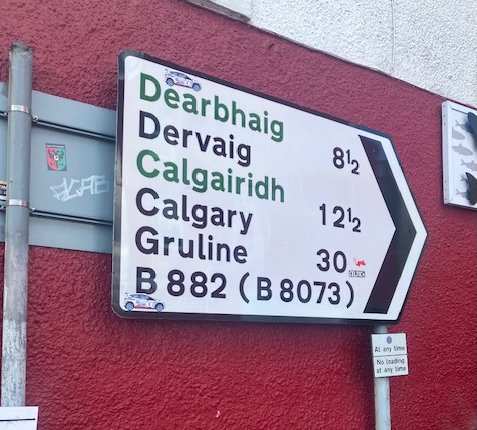
I never did get to see Calgary Bay on Mull, though I saw sign posts to it in Tobermory. The Skipper and Boat Manager took photos in Calgary Bay for me as they sailed down towards Iona. One of their photos is displayed in this article.
Editor’s note
The views, perspectives and opinions in this article are solely the author’s and do not necessarily represent those of the AMA.
Banner image: Calgary Bay, Isle of Mull (credit: Dr. Alexander Paterson)